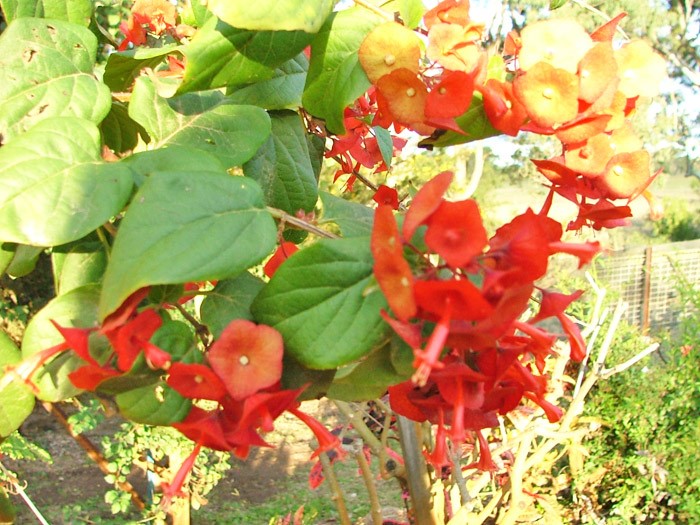
The garden continues to be a focus for both Michael and myself however the elusive inspiration to create art, music or working on new places in the garden can wane. This is even more so when the weather is dry and the garden looks a bit wilted and dusty. As much as I would like to waste my precious tank water on the garden it is just not going to happen. Plants need to tough it out and amazingly they do.
In a break from the garden the clay work has come out and for Michael the compiling of song lists for possible busking sessions in Montville. Hopefully we are on the cusp of doing something creative but for now I blame the weather.
Monday, August 28, 2017
Monday, June 5, 2017
New roses , a visit with HRIA to "Rosevale" at Samsonvale
Roses added to the garden (from Leonie Kearney)
Visited Leonie Kearney with ‘Heritage Roses in Australia’
Queensland group at ‘Rosevale’ at Samsonvale where Leonie has a large garden
and propagates and sells roses from cutting and collects seedling roses. She has many other plants in
her collection.]
'Rosevale' looking toward Leonies propagation house
FRONT PATH GARDEN
“Lionel’s Double Pink
China” A seedling, ours a cutting from the original from Woodford. with
Double pink scented blooms resembling the Tea rose Comtesse de Labarthe except
that blooms are held upright without the
Tea rose “weak neck”.
“Isabella Sprunt”
Yellow Tea Rose, said to be a sport of ‘Safrano’. Isabella Sprunt Discovered by
Rev. James M. Sprunt (United States, 1855). Introduced in United States by
Isaac Buchanan in 1865 as 'Isabella Sprunt'. Introduced in Belgium by
Verschaffelt in 1867 as 'Isabella Sprunt'. Strong fragrance. Large, semi-double (9-16 petals) bloom form
but not long lasting. Blooms in flushes
throughout the season.
Red Polyantha Low
growing , crimson to red semi-double flowers
Grandma Fredericks Tall
growing , fully double pink to crimson flowers . From Cutting of a seedling
raised at Woodford
“Camnethan House
Cherry Red” Foundling from Camnethan
House, Smeaton VIC. Tea. Cherry red, turning crimson–blue.
Camnethan House Cherry Red Tea Rose
“Gloire des Rosomanes” Introduced in France by Jean-Pierre Vibert in
before 1836 as 'Gloire des Rosomanes'. Introduced in Australia by Hazlewood
Bros. Pty. Ltd. in before 1911 as 'Gloire des Rosomanes'. China / Bengale,
Hybrid Bourbon. Plantier France, 1825.
Papillon Tea
rose, medium sized semi double blooms that start from pointed buds opening to a
melody of pink tones being richer pink petals in the middle having a yellow
base fading to creamy pink to white on the outer petals. 1881 Gilbert Nabonnand
The Shambles Rose
The Shambles Rose
Tea Rose One of
our many cuttings grown roses. The flower looked white but it is probably a
washed out Comtesse de Labarthe
SOUTH ROSE GARDEN, New bed inside the hedge. Agapathus transplanted to west of embankment.
Dan Poncet Pink blend
Grafted bare rooted shrub Carmine-pink. Strong fragrance. Full (26-40 petals), reflexed bloom
form. Dark green foliage. Guillot Bred by Dominique Massad (France,
1999).
Rosette Delizy Yellow blend Tea. From cutting Flowers
are yellow, carmine-pink edges, apricot highlights. Tea fragrance. Large, full (26-40 petals), reflexed bloom
form. Blooms in flushes throughout the
season. Clément Nabonnand (France, 1922).
The Shambles Rose
Allys Rose Pink
Multiflora
The Shambles Rose
All inter[planted with Lavender, Salvias, Abutilon, Daisies,
Kalanchoe, transplanted Sedum.
Many of our cuttings grown perennials and srub which were
overcrowding he propagation are were planted out, waiting for rain.
Saturday, May 27, 2017
The Shambles May Visitors and New plantings an developments
After a very successful visit by the Buderim Garden Club on 26 5 2017 when we had 50 visitors in perfect autumn weather some New Plants were added May 2017
Through the garden admission tea and coffee and lant and book sales a generous amount was raised for frontier services (Longreach) Through the Montville uniting Church.
NW Corner,
Rainforest Corner
Licuala ramsayii ‘Australian Fan Palm’ A medium sized, single
stemmed palm, usually up to 15 m in height, though it can reach 25 m. The stem
is normally quite straight and slender and up to 20 cm in diameter. The crown
consists of large fan-shaped leaves. The leaves up to 2 meters long, with
feather-like fronds. Occurs in NEQ from about Cooktown, south to about Ingham.
Altitudinal range from Cape Tribulation Queensland, near sea level to 1100 m.
Occurs in rainforest, swamp forest, mangroves, littoral forest and in diverse
riparian and riverine habitats, on various soil types. Licuala ramsayi (F.
Muell.) was first described in 1874 as Livistona ramsayi by Ferdinand von
Mueller. The new species was based on a collection made by Edward Pearson
Ramsay from “Rockingham’s Bay,” which was a broad location name for the area
around the coastal township of Cardwell and the mountainous Cardwell Ranges
hinterland. Ramsay was a self taught naturalist with a special interest in ornithology.
In 1876, he was appointed the first Australian-born curator of the Australian Museum.
In the original publication of L. ramsayi there is no indication of when Ramsay
had made the collection at Rockingham Bay.
Schlefflera
elegentissima syn. Plerandra
elegantissima, syn. Dizygotheca elegantissima “False Aralia’ It is an
evergreen shrub or tree. Its leaves are thin, coppery red to dark green with
toothed edges. On adult plants the leaves are much broader. In autumn it bears
clusters of pale green flowers followed by black fruit. John Gould Veitch collected
Schlefflera syn Aralia elegantissima,
which was first introduced to the world during the London ‘Great Spring Show’
of 1873. New Caledonia
Leea coccinea ‘
Hawaiian Holly’ . The Leea is a relative of the Fatsia. The burgundy Leea, also
known as Hawaiian Holly, has bronzy red foliage. Leea's are a shrubby plant
bearing large leaves with each leaf divided into numerous pointed leafletsThe
genus was named by Linnaeus after James Lee, the Scottish nurseryman based in
Hammersmith, London who introduced many new plant discoveries to England at the
end of the 18th centuryGolden Fern (not identified). Burma
Fenced Rose garden
(west end of track)
Transplanted 3 x Hymenocallis x harrisiana.’Sacred Lily
of the Incas’. Hymenocallis harrisiana Herb. is a deciduous species from
Mexico. The strap shaped leaves are glaucous, as it comes from an arid area.
The flower has a small scented corona (crown). Each flower lasts only one
night. The genus Hymenocallis was created by Richard Anthony Salisbury in
1812,[5] when he separated out a number of species formerly placed in
Pancratium, starting with Hymenocallis littoralis. The main reason for the
separation was that the fruits have only two seeds in each locule. Salisbury
explained the name as referring to the "beautiful membrane which connects
the filaments.
Central Shrub
garden (North end near grouping of
Holmskiodia sanguinea (Blue and Yellow) Chinese-hat
plant is a large, sprawling evergreen tropical shrub native to the lower
elevations of the southern Himalayas. First growing erect, the new, young
branches dart outward and weep creating a scrambling plant that is almost
vine-like. The genus name commemorates Johan Theodor Holmskiold (1731-1793), a
Danish botanist who wrote Beata ruris otia fungis Danicis, published in two
volumes in 1790 and 1799. It is native to the Himalayas (India, Pakistan,
Nepal, Bhutan, Bangladesh, Myanmar) Chinese-hat plant is a large, sprawling
evergreen tropical shrub native to the lower elevations of the southern
Himalayas. First growing erect, the new, young branches dart outward
and weep creating a scrambling plant that is almost
vine-like.
Holmskiodia
sanguinea
Holmskiodia
sanguinea ‘Mandarin Blue’
Holmskioldia
sanguinea ‘Mandarin Rouge’ (red)
Holmskiodia
sanguinea ‘Mandarin Sunrise’ (yellow-green)
Transplanted 1 x Salvia oxyphora
Central lawn and
border
Adjacent 2 mature Holmskioldia sanguinea (orange) see above.
One of our mature plantings
Holmskioldia sanguinea “Mandarin Rouge’ (red)
Apium graveolens
var. rapaceum Celeriac. Celeriac originating in the Mediterranean Basinis a
variety of celery cultivated for its edible roots, hypocotyl, and shoots.
Mentha × piperita
var. citrate Eau-de-cologne mint.
Mentha citrata has a strong lavender odor due to the two chemical constituents,
linalyl acetate (45%) and linalool (45-50%), which makes up around 90% of the
oil. The leaves and flowering plant have traditionally been claimed to have
analgesic, antiseptic, antispasmodic, carminative, cholagogic, diaphoretic, and
vasodilator properties. Like other members of the genus Mentha, it is best not
used by pregnant women because large doses can cause miscarriage.
Front path garden
Hibiscus acetosella
‘Voodoo’ (Cranberry or African Rosemallow) Deeply cut crenate leaves which are
dark maroon to a patchy red/green appearance. Solitary flowers vary in color
and are most often the dark pink to maroon that is characteristic of the
foliage with darker vein-like markings. H. acetosella first recognized in 1896
by French botanists as a distinct plant and given the name it currently has.
The plant was probably first found growing around African villages in the
southern Congo-Angola-Zambia region.
Zepheranthes citrina
(Yellow Rain Lily) A species of bulbous perennial belong to the family Amaryllidaceae. Zephyranthes citrina was described by Baker
and published in Botanical Magazine 108: pl. 6605, in 1882 Mexico
South Rose garden
Rosa ‘ MME LAMBARD’. (TEA,DOUBLE REMONTANT from cuttings) An excellent, tall sturdy and disease free
rose. The mid-pink double flowers have a sturdier neck than Comptesse de
Labarthe. Low maintenance. Lacharme, France, 1864 transplanted from below north
verandah.
Apium graveolens
var. rapaceum Celeriac. Celeriac originating in the Mediterranean Basinis a
variety of celery cultivated for its edible roots, hypocotyl, and shoots.
Cosmos
atrosanguineus, (chocolate cosmos), is a species of Cosmos, native to Mexico,
where it is extinct in the wild. The species was introduced into cultivation in
1902, where it survives as a single clone reproduced by vegetative propagation.
Cosmos atrosanguineus is a herbaceous perennial plant growing to 40–60 cm tall,
with a fleshy tuberous root. Dark maroon-brown flowers.
Below North Verandah
Plectranthus
scutellarioides. Syn Solenostemon syn. Coleus
blumei syn. Coleus scutellarioides
Short-lived perennial plant plant.The species is
extremely variable in the colour and shape of the leaves. The leaves of the
wild species may be somewhat variegated but this has been developed to an
extreme degree in cultivated varieties, whose leaves may include one or more
shades of green, white, cream, yellow, pink, red, maroon and dark purple. The
species was first described by Carl Linnaeus in 1763, as Ocimum scutellarioides. The genus Ocimum is best known for Ocimum
basilicum, sweet basil. The species was first introduced into Europe from Java
in 1851 by a Dutch horticulturalist. At this time, there were few leaf colours
and shapes. A wider variety was available by 1877, when the American William
Bull offered seeds at 43 US cents each. However, by selecting for seed
production, early flowering was inadvertently favoured, and leaf colour also
declined in intensity. Coleus breeding revived in the early 1940s, and by the
1980s, the availability of an improved range of cultivars led to coleus
becoming the tenth most important bedding crop in the US. Plectranthus
scutellarioides is native to India (including the Himalayas), Sri Lanka,
China, Burma, Thailand, Laos, Vietnam, Malaysia, Indonesia and Australia
Thursday, March 23, 2017
A wet march after a Record dry February and new plantings.
Plants added end of March 2017
A record dry February 2017 has transformed to some wet days
with over 200MM rain in the first 3 weeks of March. Days remain hot and humid
and often cloudy with persisting showers.
Justicia brandegeana Front Path garden
Mussaenda phillipica
.Mussaenda ‘Queen Sirikit’ (Mussaenda ‘Dona Hilaria x Dona Aurora’) is named
for Queen Consort of Thailand, the longest reigning head of state in the world.
It is possibly the most widely grown Mussaenda in the world. It has multiple
pale pink sepals which have a distinct darker edge. Flowers are bright yellow.
Following heavy rain, the weight of the flower heads has been known to break
branches. Mussaenda philippica (Tropical Dogwood) is native to the Philippines, Indonesia and New Guinea.
The flowers have white sepals and orangy-yellow flowers. It grows in cultivation
to a a shrub 1.8 to 2.5 metres (6 to 7 feet) high by 1.2 to 1.8 metres (4 to 6
feet) wide. This species is less widely seen than its well known cultivar
Mussaenda philippica ‘Dona Aurora’ (Dona Aurora, Buddha’s Lamp). This was a
chance sport first collected in 1915 by Calixto Mabesa on Mt Makiling and then
recollected by Hugh Curran and Mamerto Sulit at the College of Forestry grounds
at the University of the Philippines Los Banos in 1930. This cultivar has
multiple floral sepals (often 5 per flower) instead of just one. This was
propagated and dedicated in 1930 to Mrs Aurora Quezon, wife of the Philippines
President. This plant is the parent of almost all hybrids. Criss Cross garden west
border
Mussaenda phillipica “Dona Luz” Mussaenda ‘Dona Luz’ (M. ‘Dona
Hilaria x Dona Aurora’) is named after Philippines First lady Luz
Banzon-Magsaysay. It has multiple shrimp pink sepals which are inclined to turn
under at their tips. Criss Cross garden west border
Pseuderanthemum
laxiflorum ‘Purple Riot” shooting
star. This is a well-branched herbaceous perennial to small shrub with opposite
leaves and purple flowers held singly or in small groups near branch tips. This
plant is native to Polynesia Fiji Islands Central
Shrub garden
Ipomoea horsfalliae
Cardinal Creeper. This is a winter bloomer. The ruby red to magenta-violet
flowers, 4 – 7 cm in diameter. Tropical vine is named for Charles Horsfall
(1776-1846), an avid botanist who was Lord Mayor of Liverpool, and whose wife,
Dorothy, was a noted botanical artist. This spectacular plant is a native of
South America (Brazil, Guyana, Surinam
and Venezuela), and has also become naturalized in the humid forests of the
Caribbean, especially in Jamaica. It is also very common, and now naturalized,
in Hawaii, where it was introduced by Prince Kuhio (1871-1922). In its native
range the plant is almost solely fertilized by hummingbirds, and where these
are lacking or scarce, fruiting seldom occurs. Most parts of the plant are
poisonous if ingested. Arch East Border garden. SE Corner Car garage.
Bulbs
Sparaxis (Harlequin lower) Sparaxis tricolor has bright red flowers with yellow and black
centres. Many named hybrid cultivars were bred from S. bulbifera and S.
tricolor. endemic to Cape Province, South Africa. NW Corner garden
Narcissus jonquila
(Jonquil) “Paperwhite” Jonquil: This term actually refers to a specific type of
daffodil known as Narcissus jonquilla,
although the name is often used as a more general term for daffodils in certain
parts of the country. They are most easily identified by their dark green,
tube-shaped leaves as compared to other types of daffodils which have flat
leaves. Jonquils also tend to have clusters of several flowers, instead of just
one bloom, along with a strong scent. NW corner garden
Camellia sasanqua "Hiryu" . Camellias starting to flower already here.
Freesia refracta alba
Freesia alba is an herbaceous perennial growing from a corm and producing an
erect, often branched stem up to 40 cm (16 in) centimeters tall with several
leaves up to about 15 centimeters long. The inflorescence is a spike of several
fragrant flowers with usually white tepals marked with yellow and purple. The
genus Freesia is named after F.H.T. Freese (died 1876), a German physician from
Kiel and a pupil of Ecklon. Freesia has a rather complicated and confusing
history with lots of wrong names, misapplication of names and synonymy-for the
full version see the 1982 revision by Peter Goldblatt. The first two species
that were cultivated in Europe in 1766, were both placed in different genera
viz. F. corymbosa was thought to be a Gladiolus and F. caryophyllacea was
thought to be an Ixia. Freesia refracta arrived there in 1795 and was also
thought to be a Gladiolus. Freesia sparrmannii was collected in 1770 and described
in 1814, also as a Gladiolus, and the fifth species was called Gladiolus
xanthospila but this one has never been related to any wild plant and is
thought to be a form of F. caryophyllacea. Ecklon, Zeyher and Drege, all active
in the early 1800s, sent back several species including F. sparrmannii, F.
refracta, F. corymbosa, F. leichtlinii and F. andersoniae. It was only in 1866
that Freesia was described as a distinct genus. Freesia alba was first
described in 1878 by G.L.Meyer, and became well known in Europe, as F. refracta
var. alba. Gumbleton recognized Freesia alba as a distinct species in 1896. There
is no record of how it got there, but Freesia
alba first appeared in the English nursery trade in 1878 and quickly spread
to Europe and North America. It appears to have caused quite a sensation, Cape
province South Africa. NW corner garden
Allium sphaerocephalon
“Drumsticks” Ornamental onions have small vibrant flower heads that change from
green to a red-purple. Front path garden where hopefully they won't rot in present wet days.
Wednesday, March 1, 2017
What is a garden?
Have people forgotten what a garden is ?
I imagine that in many cases some people would have no idea of the sensory delight of a full blown garden that relies on plants, design and maturity. I was really looking forward to the latest tv show about garden design but yet again there is so much focus on start from scratch creation of a designed space. Scary amounts of money are spent and major earth moving is often the norm.
Horses for courses .
People who visit our garden so often say they would like to have a garden like ours.A garden is never finished and even at 25 years in our care The Shambles will always be changing purely because plants grow, some die and we just get design ideas that will only make it more interesting.
It is the layers of maturity which is really only achievable by staying in one place and not selling up every couple of years.
I have been burnt in the past by people who ask for plants which I am always happy to give only to find out that they are selling the property just when things are taking off. Prorogation takes time and in the case of roses it is often by the second year that they are ready to plant out.
Often I am asked to visit a garden and to make suggestions of how to make it more manageable or to redesign it. It is so essential to get a good understanding of what the owner wants and their level of commitment because most gardens take work. It is also essential to value what is already in the garden and what past gardeners have done. The remnant plants will inform me of what grows well on the site. Taking note of the hard landscaping that has already been imposed on a site is also necessary and can either help or hinder a project. Rediscovering focal points and views or simply reducing tree branches can change the whole feeling of a garden letting in sunlight even into the interiors of the house.
I think that some garden designers have lost the plot . I think that so many suburban gardens are being treated so heavily with hard landscaping and a very small range of plants that not even bees and butterflies will want to visit. I'm not sure but if the next housing estate held back on the concrete driveways and 6ft high fences and loosened up the planting maybe there could be somewhere for the kids to play .There is a difference between garden landscapers , garden designers and gardeners and if you want a garden that is one thing but if you want an outdoor room that is something quite different.
Kyleigh
Monday, February 27, 2017
The Doctors wife
I happened to see a sweaty lycra clad lady emerging from a gym when it occurred to me that any exercise that doesn't involve dirt and minor injury is not my thing. As for lycra or having to go and purchase the stuff -I don't think so. My gardening attire is strictly rags with pockets.My clothes actually wear out to the stage of compost when I finally discard them. There are so many benefits to using your garden as an exercise space. The over loaded wheel barrows require speed and balance as they are pushed around the garden down to the mulch pile or fire pit. Plenty of deep bends can be achieved just picking stuff up , lugging pots along with wrestling the dog for the palm fronds or the mower. Upper body stretches and toning is all part of reaching those dead branches and bringing shrubs down in height .Cleaning out gutters and climbing up on the shed roof is another one for balance. It is all about the struggle and not being arsed to go and get a ladder or wait for help.
Then there are the rocks. There is so often a need to move rocks around and the trusty furniture remover is ideal for this -there will often be several attempts at making the rock stay on but that is all part of the exercise routine. Digging is great for the arms and the therapeutic buzz you get from an open fire is rarely done at an indoor gym. Our dog "Shadow " is so fond of palm fronds that he will attempt to drag them off the fire in full blaze - that is when your sprint comes in.
The thing about exercise in the garden is that you don't have to drive anywhere and it can take all day so there has to be some positive out come for all that physical activity. The worst thing is discovering that you have run out of milk or something and need to do the quick dash out in the real world where real people are . That is when I or others notice my state of attire -OMG is that the Doctors wife?
Kyleigh
New Paths, New plantings at The Shambles February 2017
The newly paved paths around the old house and north to the Plough Inn are finished and after a record hot, dry february a little rain and some showers have encouraged some transplanting, planting from our own stock and buying new plants.
New Paths front path garden.
From our own stock
Aloysia triphylla (Lemon Verbena)
Clerodendron ugandense (Blue Butterfly bush)
Lavandula spp (Lavender from cuttings at Montville School)
Chrysantheum
frutescens cultivar)
Transplanted
Clivea miniata (Orange and
Yellow)
Liriope
cultivar
Justicia brandegeana (yellow
shrimp plant)
New plant from Leighanne Gerbera cultivars x 2
New paths South Rose garden
New plants Coreopsis grandiflora 'Calypso' is a clump forming herbaceous
perennial with cream and yellow variegated foliage and golden yellow flowers
with a ring of red around large yellow centres in summer. Garden edge South
Rose Garden
Tulbaghia violacea 'Variegata'.
Variegated society garlic garden edge
South rose garden
Dianthus chinenesis Pinks from throw out
bin Sunray Nursery
New paths Azalea garden South Rose garden
(Northern side)
Azalea, Rhododendron indica “Dr Arnold”
A small single Azalea, bears cherry pink flowers tinged with mauve flowers.
Apparently hybridizd by Camellia Lodge Nursery, or possibly the Netherlands.
Azalea, Rhododendron rutherfordiana indica “Firelight” Rutherford Indica.
Semi-double frilly red flowers on strong bush
Stone Circle Garden
New plants Abelia gradiflora variegata "Variegated Abelia". It has a
natural rounded habit and produces masses of small white flowers in Spring,
Summer and Autumn. The leaves are green and broadly edged with white with new
pink growth.
Euphorbia hypericifolia “Diamond Frost” grows to a 50cm cushion and
is spangled almost all year round with tiny, white flowers. Africa
From our own cuttings Weigela
alba
New paths South East Corner, East border garden
Strobilanthus
dyerianus (Persian shield) Soft
stemmed shrub with thick, quilted purple leaves to 6 inches long splashed with
iridescent pewter or silver. In autumn, it bears delicate funnel-shaped violet
flowers in an eye-catching spike formation
Scutellaria costaricana (Scarlet skullcap) Tender perennial
native to Costa Rica, where it grows in the mountain forests at elevations as
high as 2,000 m (6,500 ft). It is grown as a house plant for its orange- red
flowers which are borne in rich terminal clusters. It is a member of the mint
family
Transplanted to path edges Chlorophytum comosum, (Variegated spider plant syn. airplane plant,
St. Bernard's lily, spider ivy, ribbon plant, hen and chickens) is a flowering
perennial herb. It is native to tropical and southern Africa, but has become
naturalized in other parts of the world, including Australia
New paths east
border gardens
From our own stock
Pycnostachys urticifolia evergreen shrub produces vivid blue
flowers shaped like a witches hat in autumn and winter. Growing at the tips of
the branches
Salvia pallida Pale Sage. Tall, Oval
leaves scalloped edges, pale blue flowers
Justicia aurea Yellow Justicia
Begonia fuchsioides Begonia with bright
red Fuchsia like flower clusters
Stachytarpheta mutabilis
Chrysanthemum frutescens hydrid ith low
growth white flowers
From Rowena Cavanagh
Tecomanthe hillii ? Tecomanthe speciosa Yellow fast growing
climber which flowers profusely in spring. Dense green foliage with bunches of
soft yellow tubular flowers which fade to a pale pink as they fall off the
vine. Full sun to part shade. On new arch East border garden.
Added Festuca glauca Blue Fescue clump-forming
ornamental grass noted for its glaucous, finely-textured, blue-gray foliage
Hemigraphis exotica “Polywaffle”
compact, prostrate, evergreen tropical perennial with small, dark green and
burgundy leaves and tiny white flowers. The oval leaves are crinkled with
curled edges and look rough and rigid but feel soft to the touch
Transplanted Ophiopogon Mondo grass
New paths Fenced Rose garden
Removed then replanted Tetradenia
riparia syn. Iboza riparia
From our stock Neomarica
caerulea
Neomarica longifolia
Liorope cultivar
Added Cordylline Australis “Red sensation”
deep red foliage all year round. It has thin, long hardy leaves that branch off
the main stem
Behind pool Fence Banksia ericifolia x collina “Giant Candles”
Gerbera hybrida
is a garden hybrid from the genus of
plants Asteraceae (daisy family). It was named in honour of German botanist and
medical doctor Traugott Gerber (1710-1743) who travelled extensively in Russia
and was a friend of Carl Linnaeus. Gerbera is native to tropical regions of
South America, Africa and Asia. The first scientific description of a Gerbera
was made by J.D. Hooker in Curtis's Botanical Magazine in 1889 when he
described Gerbera jamesonii, a South African species also known as Transvaal
daisy or Barberton Daisy. Gerbera is also commonly known as the African Daisy. The
domesticated cultivars are mostly a result of a cross between Gerbera jamesonii
and another South African species Gerbera viridifolia. The cross is known as
Gerbera hybrida. Thousands of cultivars exist. Front Path garden Gift from LeighAnne Lawrence
Subscribe to:
Posts (Atom)