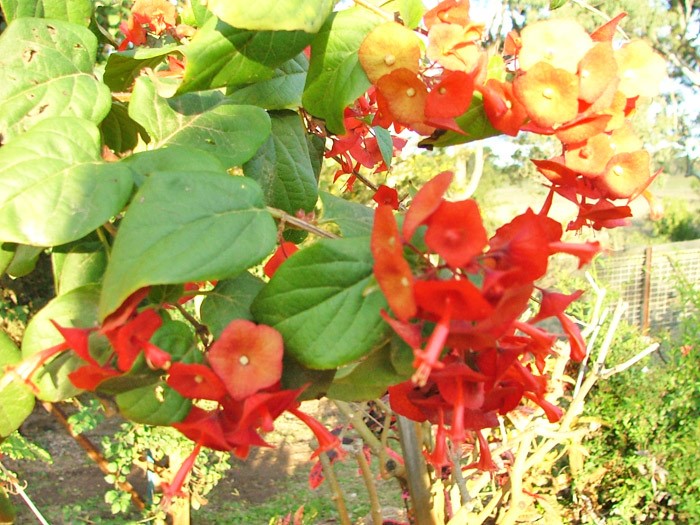
It was lovely to talk to the visitors in the garden yesterday and very fortunate that it wasn't today as it has been rainy and cool.It certainly was a very relaxed opening for us and I am pleased that people were interested in the garden and ready to go home and work in their own gardens which is the whole idea.
Unexpectedly we had friends arrive and stay on for dinner . Luckily we have the "Lazy Rabbit' nearby so we could buy a delicious Japanese take away.
This afternoon I have been out picking roses for the house before they get too sodden.
Sunday, November 12, 2017
Thursday, November 9, 2017
Open Garden this Saturday Afternoon 11/11/17
For years we have opened our garden according to a date on the calendar and often it isn't the best time . When trying to prepare a long term lead up for a garden to be ready for the public so many things come into play . The weather for a start along with preparing plants to sell and coordinating refreshments and willing helpers . This weekend is a no frills version of an open garden and it will probably feel a bit more laid back and less frantic than the more organised opening. The preparation for this weekend began just a couple of days ago and has included nothing more than a couple of flyers, a mention on face book and word of mouth. It doesn't matter if 5 people come along or 50. The garden itself has had a huge boost from mother nature and loads of attention from me as usual. I really love my garden and both Michael and I get great satisfaction from it as it continues to mature . We know that you have to be here all the time to really appreciate the subtle changes and the growth of plants. It can be something as transient as the fog that gives the garden a magical appearance. We are opening and sharing the garden this Saturday afternoon purely because it is looking lovely at the moment and there are several shrubs in full flower and a few areas in progress to look at.
This garden is not a show garden, it has weeds and doesn't stay inside the edges . It is a robust place where our family and friends get together and where children and dogs play . Honestly some people just go over the top with garden neatness & their outdoor eating preparation. Our kids had "picnics" that consisted of a brisk walk at the falls followed by a a drink of water and an apple. Here we have the remnants of an impromptu feast down the back yard. Everything tastes better outdoors! Feel free to bring along your own afternoon tea or special beverage on Saturday. We once gave a bus load of visitors a glass of wine each and they staggered out at the end with high praise and a smile on their faces. Kyleigh
Wednesday, November 8, 2017
The Shambles Open One Afternoon, Saturday 11th November 2017, 2pm til 5pm
Just remember please, "The Shambles" is open this weekend 11th November 2017 from 2pm to 5pm to take advantage of the dranmatic response to our recent rain and good weather.
Gold Coin entry Front Path Garden
No plant stalls or food but a lovely opportunity to walk around the garden when there is so much in flower
Spiraea cantoniensis
Lilium,Hippeatrum, Neomarica caerulea
Some plants added nov 2017
Duranta Lorentzii (Vanilla scented Duranta) syn. Duranta serratifolia lush lime green evergreen shrub! The sparkling white blooms smell of sweet vanilla and so attractive to bees and butterflies. Duranta serratifolia was already described and the name validly published by August Heinrich Rudolf Grisebach. It was Carl Ernst Otto Kuntze, however, who reclassified it into todays valid botanical systematics in 1898.Duranta serratifolia is native to Argentina. Fenced Rose garden
Coffee arabica is originally from Yemen on the Arabian peninsula, Arabica is thought to be the first species of coffee to be cultivated and many consider it to be a superior coffee type.The earliest credible evidence of coffee-drinking appears in the middle of the 15th century in the Sufi shrines of Yemen. It was here in Arabia that coffee seeds were first roasted and brewed in a similar way to how it is now prepared. Coffee seeds were first exported from East Africa to Yemen, as the coffea arabica plant is thought to have been indigenous to the former. Yemeni traders took coffee back to their homeland and began to cultivate the seed. By the 16th century, it had reached Persia, Turkey, and North Africa. From there, it spread to Europe and the rest of the world.The word "coffee" entered the English language in 1582 via the Dutch koffie, borrowed from the Ottoman Turkish kahve, in turn borrowed from the ArabicGah-wah . The Dutch East India Company (VOR) was the first to import coffee on a large scale. The Dutch later grew the crop in Jva and Ceylon The first exports of coffee from Java to the Netherlands occurred in 1711. Through the efforts of the British east India Company, coffee became popular in England as well. Oxford's Queen's Lane Coffee House, established in 1654, is still in existence today. Coffee was introduced in France in 1657, and in Austria and Poland after the 1683 Battle of Vienna when coffee was captured from supplies of the defeated Turks. Coffee Trees are attractive with dark glossy leaves and striking red berries. They take around seven years to mature and grow to about 5 metres but can be trimmed to two metres for easier harvest. Coffee is relatively pest free and will grow well in rich or improved soils. Small white flowers appear two to four years after planting and produce a Jasmine-like fragrance. The flowers only last a few days then the green berries begin to appear, ripening and deepening to a bright red. Coffee grows best in semi-shade between around 15-25C
Livistona chinensis The Chinese Fan Palm is a beautiful solitary fan palm that will eventually reach 8 -12 meters. With lush fan shaped leaves, this is an absolutely stunning Palm that produces small cream colored flowers then large bunches of attractive blue fruit! Plants available approx 30-40cm tall! Livistona chinensis; the genus is named for the baron of Livingston. There are two subspecies; Livistona chinensis var. chinensis, China Southeast, and Vietnam. And Livistona chinensis var. subglobosa, Bermuda, Florida, Hawaii, Japan, Jawa, Marianas, Mauritius, Nansei-shoto, New Caledonia, La RĂ©union, and Taiwan. Livistona chinensis was first described as Latania chinensis (Jacquin, 1801), from plants cultivated and subsequently naturalised in Mauritius and brought to Schoenbrunn Gardens, Vienna in 1788. It is lectotypified by the illustration in Jacquin (1801), Tab. 11, Fig. 1. The species name was taken from that used for the palm in Mauritius, “Latanier de la Chine”. Bretschneider (1898) provided some evidence to suggest that the naturalist and traveller Pierre Poivre was responsible for introducing the palm, during the mid 1700s, to Mauritius where it soon became naturalised. Poivre had made extensive collections of plants from southeast China and Indochina during the period 1740-1767. Martius (1838) provided the transfer to Livistona, based on Brown (1810) who suggested it should correctly have been in Livistona, but without formal transfer. For NW corner rainforest.
Spathiphyllum cochlearispathum is native to southern Mexico and often cultivated. The species was originally described by Frederik Liebmann in a separate genus Hydnostachyon, which he described as having a concave (spoon-like) spathe Spatha foliacea persistens cochleariformis, from which he formed the species epithet cochlearispathum. The species was moved to the genus Spathiphyllum by Heinrich Gustav Adolf Engler Spathiphyllum Certain species of Spathiphyllum are commonly known as Spath or peace lilies.
They are evergreen perennials with large leaves 12–65 cm long and 3–25 cm broad. The flowers are produced in a spadix, surrounded by a 10–30 cm long, white, yellowish, or greenish spathe. The plant does not need large amounts of light or water to survive. NW Rainforest area
Also yet to be desribed
Some new Bromeliads, Palms, Begonias, Hibiscus cuttings and a Dianthus/Carnation type to be identified.
Sunday, September 17, 2017
Severe Dry and failure of Usual spring Display
Dead dry after a record hot dry winter and now failure of any spring rains. We have bought water for our tanks for the third time this season with no sign of relief. The pool has "split' it's fibreglass skin and requires repair for the first time in 20 years.
In spite of all this has a bus tour of 40 from Hervey Bay in the garden today and the maturity of the garden has safeguarded it from sever damage during this time.
Hippeastrum papilio 'The Shambles'
Plants
added August/ September 2017
Brunfelsia
latifolia variegata Fenced Rose garden
Petraeovitex bambusitrum
syn P. wolfeii
‘Curtains of Gold’ ‘Wolfes Vine’
Vigourous climber with cream coloured flower bracts, discovered by Dr E
D Wolfe in 1938 Malaysia, Southern
Thailand. NW Corner Garden
Anigozanthos x
hydrid
‘Tenacity’ Yellow flowering NW Corner garden
Anigozanthos x
hybrid
‘Bush Ballad’ Red Flowering NW Corner
Linaria,
Allysum, Sedum, Kalanchoe, Borage all added along front path garden. Large Pots near back stairs trialling Sage,
Margoram, Mints, Lavender, Rosemary and other pot herbs.
'Tawny Frog Mouth' waiting for the pool to stop leaking
Callistemon
viminalis
“Captain Cook” Criss Cross Garden west
Callistemon
viminalis
“Red Accent” East of Pool Fence
Photinea x
fraseri
“Red Robyn” x 4 Criss Cross Garden west border
Raphiolepis
delacourtii x indica
“Apple Blossom” East border NE corner of
house
Metrosideros
collina
“Firecracker” Variegated or variable flowering plant in the family Myrtaceae.
It is native to French Polynesia and the Cook islands. The species was
first formally described by botanist Johann Reinhold Forster and his son Georg
Forster in 1775. It was given the name Leptospermum collinum.
Althaea
officinalis
(marsh-mallow,[2] marsh mallow is a perennial species indigenous to Europe,
Western Asia, and North Africa, which is used as a medicinal plant and
ornamental plant. Pink single flowers on an erect branching structure. A
confection made from the root since ancient Egyptian time evolved into today's
marshmallow treat. Central Shrub Garden
"Shadow" waiting for rain
Buddleja
davidii 'Black Knight' has been one of the most successful davidii cultivars
ever released. A selection made by Ruys at the Moerheim Nursery, Dedemsvaart,
Netherlands, circa 1959, it was accorded the RHS Award of Garden Merit in 1993.
Central Lawn and Border Garden.
Scented
Pelargoniums ‘Pine”, ‘Rose’, ‘Ginger’
and others in raised garden box
Rosa
banksiae alba, (Single White) Lady
Banks' rose, Banks' rose, The rose is
named for Lady Banks, the wife of the botanist Sir Joseph Banks. It is a
species of spring flowering, native to central and western China, in the
provinces of Gansu, Guizhou, Henan, Hubei, Jiangsu, Sichuan and Yunnan, at
altitudes of 500–2,200 m. The species was introduced to Europe by William Kerr,
who had been sent on a plant-hunting expedition by Sir Joseph Banks. He bought
the first Lady Banks' Rose, subsequently named the white Lady Banks (R.
banksiae var. banksiae) from the famous Fa Tee nursery in 1807
Rosa ‘RENAE’ Medium pink Floribunda, Climber. From cutting Thornless, repeat flowering Bred
by Ralph S.
Moore (United States, 1954)
Monday, August 28, 2017
On the cusp
The garden continues to be a focus for both Michael and myself however the elusive inspiration to create art, music or working on new places in the garden can wane. This is even more so when the weather is dry and the garden looks a bit wilted and dusty. As much as I would like to waste my precious tank water on the garden it is just not going to happen. Plants need to tough it out and amazingly they do.
In a break from the garden the clay work has come out and for Michael the compiling of song lists for possible busking sessions in Montville. Hopefully we are on the cusp of doing something creative but for now I blame the weather.
Monday, June 5, 2017
New roses , a visit with HRIA to "Rosevale" at Samsonvale
Roses added to the garden (from Leonie Kearney)
Visited Leonie Kearney with ‘Heritage Roses in Australia’
Queensland group at ‘Rosevale’ at Samsonvale where Leonie has a large garden
and propagates and sells roses from cutting and collects seedling roses. She has many other plants in
her collection.]
'Rosevale' looking toward Leonies propagation house
FRONT PATH GARDEN
“Lionel’s Double Pink
China” A seedling, ours a cutting from the original from Woodford. with
Double pink scented blooms resembling the Tea rose Comtesse de Labarthe except
that blooms are held upright without the
Tea rose “weak neck”.
“Isabella Sprunt”
Yellow Tea Rose, said to be a sport of ‘Safrano’. Isabella Sprunt Discovered by
Rev. James M. Sprunt (United States, 1855). Introduced in United States by
Isaac Buchanan in 1865 as 'Isabella Sprunt'. Introduced in Belgium by
Verschaffelt in 1867 as 'Isabella Sprunt'. Strong fragrance. Large, semi-double (9-16 petals) bloom form
but not long lasting. Blooms in flushes
throughout the season.
Red Polyantha Low
growing , crimson to red semi-double flowers
Grandma Fredericks Tall
growing , fully double pink to crimson flowers . From Cutting of a seedling
raised at Woodford
“Camnethan House
Cherry Red” Foundling from Camnethan
House, Smeaton VIC. Tea. Cherry red, turning crimson–blue.
Camnethan House Cherry Red Tea Rose
“Gloire des Rosomanes” Introduced in France by Jean-Pierre Vibert in
before 1836 as 'Gloire des Rosomanes'. Introduced in Australia by Hazlewood
Bros. Pty. Ltd. in before 1911 as 'Gloire des Rosomanes'. China / Bengale,
Hybrid Bourbon. Plantier France, 1825.
Papillon Tea
rose, medium sized semi double blooms that start from pointed buds opening to a
melody of pink tones being richer pink petals in the middle having a yellow
base fading to creamy pink to white on the outer petals. 1881 Gilbert Nabonnand
The Shambles Rose
The Shambles Rose
Tea Rose One of
our many cuttings grown roses. The flower looked white but it is probably a
washed out Comtesse de Labarthe
SOUTH ROSE GARDEN, New bed inside the hedge. Agapathus transplanted to west of embankment.
Dan Poncet Pink blend
Grafted bare rooted shrub Carmine-pink. Strong fragrance. Full (26-40 petals), reflexed bloom
form. Dark green foliage. Guillot Bred by Dominique Massad (France,
1999).
Rosette Delizy Yellow blend Tea. From cutting Flowers
are yellow, carmine-pink edges, apricot highlights. Tea fragrance. Large, full (26-40 petals), reflexed bloom
form. Blooms in flushes throughout the
season. Clément Nabonnand (France, 1922).
The Shambles Rose
Allys Rose Pink
Multiflora
The Shambles Rose
All inter[planted with Lavender, Salvias, Abutilon, Daisies,
Kalanchoe, transplanted Sedum.
Many of our cuttings grown perennials and srub which were
overcrowding he propagation are were planted out, waiting for rain.
Saturday, May 27, 2017
The Shambles May Visitors and New plantings an developments
After a very successful visit by the Buderim Garden Club on 26 5 2017 when we had 50 visitors in perfect autumn weather some New Plants were added May 2017
Through the garden admission tea and coffee and lant and book sales a generous amount was raised for frontier services (Longreach) Through the Montville uniting Church.
NW Corner,
Rainforest Corner
Licuala ramsayii ‘Australian Fan Palm’ A medium sized, single
stemmed palm, usually up to 15 m in height, though it can reach 25 m. The stem
is normally quite straight and slender and up to 20 cm in diameter. The crown
consists of large fan-shaped leaves. The leaves up to 2 meters long, with
feather-like fronds. Occurs in NEQ from about Cooktown, south to about Ingham.
Altitudinal range from Cape Tribulation Queensland, near sea level to 1100 m.
Occurs in rainforest, swamp forest, mangroves, littoral forest and in diverse
riparian and riverine habitats, on various soil types. Licuala ramsayi (F.
Muell.) was first described in 1874 as Livistona ramsayi by Ferdinand von
Mueller. The new species was based on a collection made by Edward Pearson
Ramsay from “Rockingham’s Bay,” which was a broad location name for the area
around the coastal township of Cardwell and the mountainous Cardwell Ranges
hinterland. Ramsay was a self taught naturalist with a special interest in ornithology.
In 1876, he was appointed the first Australian-born curator of the Australian Museum.
In the original publication of L. ramsayi there is no indication of when Ramsay
had made the collection at Rockingham Bay.
Schlefflera
elegentissima syn. Plerandra
elegantissima, syn. Dizygotheca elegantissima “False Aralia’ It is an
evergreen shrub or tree. Its leaves are thin, coppery red to dark green with
toothed edges. On adult plants the leaves are much broader. In autumn it bears
clusters of pale green flowers followed by black fruit. John Gould Veitch collected
Schlefflera syn Aralia elegantissima,
which was first introduced to the world during the London ‘Great Spring Show’
of 1873. New Caledonia
Leea coccinea ‘
Hawaiian Holly’ . The Leea is a relative of the Fatsia. The burgundy Leea, also
known as Hawaiian Holly, has bronzy red foliage. Leea's are a shrubby plant
bearing large leaves with each leaf divided into numerous pointed leafletsThe
genus was named by Linnaeus after James Lee, the Scottish nurseryman based in
Hammersmith, London who introduced many new plant discoveries to England at the
end of the 18th centuryGolden Fern (not identified). Burma
Fenced Rose garden
(west end of track)
Transplanted 3 x Hymenocallis x harrisiana.’Sacred Lily
of the Incas’. Hymenocallis harrisiana Herb. is a deciduous species from
Mexico. The strap shaped leaves are glaucous, as it comes from an arid area.
The flower has a small scented corona (crown). Each flower lasts only one
night. The genus Hymenocallis was created by Richard Anthony Salisbury in
1812,[5] when he separated out a number of species formerly placed in
Pancratium, starting with Hymenocallis littoralis. The main reason for the
separation was that the fruits have only two seeds in each locule. Salisbury
explained the name as referring to the "beautiful membrane which connects
the filaments.
Central Shrub
garden (North end near grouping of
Holmskiodia sanguinea (Blue and Yellow) Chinese-hat
plant is a large, sprawling evergreen tropical shrub native to the lower
elevations of the southern Himalayas. First growing erect, the new, young
branches dart outward and weep creating a scrambling plant that is almost
vine-like. The genus name commemorates Johan Theodor Holmskiold (1731-1793), a
Danish botanist who wrote Beata ruris otia fungis Danicis, published in two
volumes in 1790 and 1799. It is native to the Himalayas (India, Pakistan,
Nepal, Bhutan, Bangladesh, Myanmar) Chinese-hat plant is a large, sprawling
evergreen tropical shrub native to the lower elevations of the southern
Himalayas. First growing erect, the new, young branches dart outward
and weep creating a scrambling plant that is almost
vine-like.
Holmskiodia
sanguinea
Holmskiodia
sanguinea ‘Mandarin Blue’
Holmskioldia
sanguinea ‘Mandarin Rouge’ (red)
Holmskiodia
sanguinea ‘Mandarin Sunrise’ (yellow-green)
Transplanted 1 x Salvia oxyphora
Central lawn and
border
Adjacent 2 mature Holmskioldia sanguinea (orange) see above.
One of our mature plantings
Holmskioldia sanguinea “Mandarin Rouge’ (red)
Apium graveolens
var. rapaceum Celeriac. Celeriac originating in the Mediterranean Basinis a
variety of celery cultivated for its edible roots, hypocotyl, and shoots.
Mentha × piperita
var. citrate Eau-de-cologne mint.
Mentha citrata has a strong lavender odor due to the two chemical constituents,
linalyl acetate (45%) and linalool (45-50%), which makes up around 90% of the
oil. The leaves and flowering plant have traditionally been claimed to have
analgesic, antiseptic, antispasmodic, carminative, cholagogic, diaphoretic, and
vasodilator properties. Like other members of the genus Mentha, it is best not
used by pregnant women because large doses can cause miscarriage.
Front path garden
Hibiscus acetosella
‘Voodoo’ (Cranberry or African Rosemallow) Deeply cut crenate leaves which are
dark maroon to a patchy red/green appearance. Solitary flowers vary in color
and are most often the dark pink to maroon that is characteristic of the
foliage with darker vein-like markings. H. acetosella first recognized in 1896
by French botanists as a distinct plant and given the name it currently has.
The plant was probably first found growing around African villages in the
southern Congo-Angola-Zambia region.
Zepheranthes citrina
(Yellow Rain Lily) A species of bulbous perennial belong to the family Amaryllidaceae. Zephyranthes citrina was described by Baker
and published in Botanical Magazine 108: pl. 6605, in 1882 Mexico
South Rose garden
Rosa ‘ MME LAMBARD’. (TEA,DOUBLE REMONTANT from cuttings) An excellent, tall sturdy and disease free
rose. The mid-pink double flowers have a sturdier neck than Comptesse de
Labarthe. Low maintenance. Lacharme, France, 1864 transplanted from below north
verandah.
Apium graveolens
var. rapaceum Celeriac. Celeriac originating in the Mediterranean Basinis a
variety of celery cultivated for its edible roots, hypocotyl, and shoots.
Cosmos
atrosanguineus, (chocolate cosmos), is a species of Cosmos, native to Mexico,
where it is extinct in the wild. The species was introduced into cultivation in
1902, where it survives as a single clone reproduced by vegetative propagation.
Cosmos atrosanguineus is a herbaceous perennial plant growing to 40–60 cm tall,
with a fleshy tuberous root. Dark maroon-brown flowers.
Below North Verandah
Plectranthus
scutellarioides. Syn Solenostemon syn. Coleus
blumei syn. Coleus scutellarioides
Short-lived perennial plant plant.The species is
extremely variable in the colour and shape of the leaves. The leaves of the
wild species may be somewhat variegated but this has been developed to an
extreme degree in cultivated varieties, whose leaves may include one or more
shades of green, white, cream, yellow, pink, red, maroon and dark purple. The
species was first described by Carl Linnaeus in 1763, as Ocimum scutellarioides. The genus Ocimum is best known for Ocimum
basilicum, sweet basil. The species was first introduced into Europe from Java
in 1851 by a Dutch horticulturalist. At this time, there were few leaf colours
and shapes. A wider variety was available by 1877, when the American William
Bull offered seeds at 43 US cents each. However, by selecting for seed
production, early flowering was inadvertently favoured, and leaf colour also
declined in intensity. Coleus breeding revived in the early 1940s, and by the
1980s, the availability of an improved range of cultivars led to coleus
becoming the tenth most important bedding crop in the US. Plectranthus
scutellarioides is native to India (including the Himalayas), Sri Lanka,
China, Burma, Thailand, Laos, Vietnam, Malaysia, Indonesia and Australia
Subscribe to:
Posts (Atom)